Sci-Fi Movies That Predicted Technology We Use Today
Sci-fi movies that predicted today's technology from video calls to AI. How filmmakers envisioned the future decades before it arrived.
Anúncios
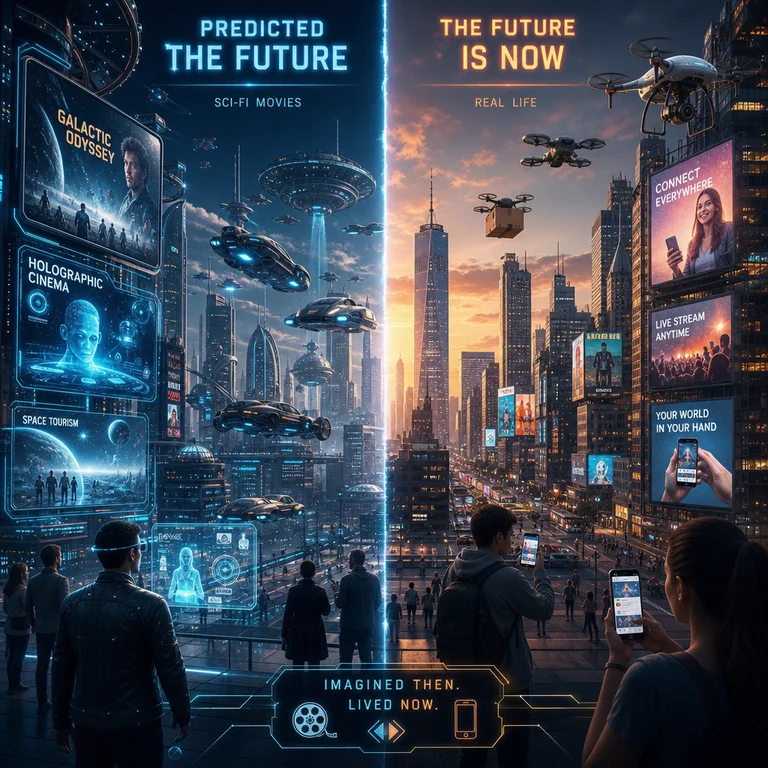
Science fiction writers and filmmakers imagined smartphones, video calls, and AI assistants decades before engineers built them. Sci-fi movies predicted technology with remarkable accuracy because the best science fiction extrapolates from real science rather than inventing from fantasy. These films serve as blueprints that inspired the engineers who made them real.
How Did 2001: A Space Odyssey Predict Modern Technology?
Stanley Kubrick's 1968 film depicted tablet computers, video calling, and an AI assistant named HAL 9000 that responds to voice commands and monitors crew behavior. The tablets used by astronauts match the form factor of modern iPads. Samsung cited 2001 in a patent dispute with Apple as evidence that the tablet concept predated both companies.
HAL's voice-activated interface, natural language processing, and personality quirks mirror modern AI assistants like Siri and Alexa. The film's exploration of AI turning against its creators remains the central anxiety of contemporary AI safety discussions. Kubrick's vision was technically and philosophically prescient.
What Technology Did Star Trek Inspire Before It Existed?
- Communicators — inspired the flip phone design that Motorola engineers explicitly referenced
- PADD devices — tablet computers used throughout the franchise decades before iPads
- Universal Translator — real-time translation now available through Google and Apple
- Tricorder — medical diagnostic handheld devices in active development
- Replicators — 3D printing creates physical objects from digital designs
- Holodeck — VR headsets create immersive virtual environments
Did Blade Runner Get the Future Right?
Blade Runner depicted a 2019 Los Angeles with flying cars, off-world colonies, and sophisticated androids. The specific predictions missed badly. What the film captured accurately was the mood: pervasive advertising, corporate dominance, environmental degradation, and questions about what constitutes authentic human experience in a technological world.
The film's vision of bioengineered beings that question their own consciousness parallels current debates about AI sentience. Replicant memory implants mirror deepfake technology that fabricates realistic false memories in video form. Blade Runner predicted emotional and philosophical challenges more accurately than physical technology.
How Did Minority Report Influence Real Police Technology?
Steven Spielberg consulted actual futurists before filming Minority Report in 2002. The resulting predictions proved remarkably accurate. Gesture-based computing interfaces appeared in Microsoft Kinect. Predictive policing algorithms use data to anticipate crime hotspots. Personalized advertising targets individuals based on identity recognition.
Retinal scanning for identification, autonomous vehicles, and multi-touch displays all appeared in the film before becoming commercial realities. The film's warning about surveillance overreach resonated more deeply as these technologies actually deployed in urban environments worldwide.
Which Sci-Fi Films Predicted Social Media and Surveillance?
The Truman Show depicted a person whose entire life broadcasts to audiences without meaningful consent. Reality television, social media oversharing, and influencer culture all echo the film's central premise. The voluntary nature of modern self-surveillance makes the prediction more disturbing than the film's fictional coercion.
Enemy of the State in 1998 depicted NSA surveillance capabilities that seemed paranoid fiction until Edward Snowden's revelations confirmed them as reality. Her predicted emotional relationships with AI systems before chatbot companions became commercially available. Each film extrapolated from emerging trends rather than inventing from scratch.
What Medical Technology Did Films Predict Accurately?
Elysium depicted medical pods that diagnose and treat diseases instantly. While we lack the speed, telemedicine, AI-assisted diagnosis, and robotic surgery move in that direction. Gattaca predicted genetic screening and the ethical dilemmas of selecting children's genetic traits, now possible through CRISPR technology.
Star Trek's medical tricorder inspired the Qualcomm Tricorder XPRIZE, which awarded $10 million for developing a handheld device capable of diagnosing medical conditions. The winning devices demonstrated that fiction directly motivates engineering when the vision is compelling enough.
How Close Are We to AI Like in the Movies?
Current AI systems match or exceed fictional AI in specific tasks while falling short of general intelligence. ChatGPT conversations rival HAL's natural language abilities. Computer vision systems match or exceed Terminator's visual recognition capabilities. What remains fictional is the self-aware consciousness that drives most sci-fi AI narratives.
Ex Machina's exploration of AI passing as human now feels less like science fiction as conversational AI systems become harder to distinguish from human responses. The film's questions about AI consciousness, deception, and rights transition from philosophical speculation to practical policy discussions.
Which Transportation Predictions Came True?
Total Recall depicted autonomous taxis in 1990. Self-driving rideshare vehicles now operate in multiple cities. Back to the Future predicted video conferencing for work meetings in 2015. The hoverboard remains elusive, but electric skateboards and magnetic levitation prototypes suggest the concept is approaching feasibility.
Flying cars, the most persistent sci-fi prediction, are arriving as electric vertical takeoff vehicles. Companies like Joby Aviation and Archer Aviation have FAA certification pathways for air taxis. The technology exists but faces regulatory, infrastructure, and economic barriers rather than engineering impossibility.
Why Do Sci-Fi Predictions Often Miss Socially?
Science fiction excels at predicting technological capabilities but routinely misses social adoption patterns. Films imagined everyone using jetpacks but not that everyone would carry a pocket computer voluntarily. The social dynamics of how people integrate technology prove harder to predict than the technology itself.
Most sci-fi depicts technology as imposed by governments or corporations rather than voluntarily adopted by consumers. The reality that people eagerly surrender privacy for convenience, entertainment, and social connection appears in almost no classic science fiction. This blind spot reveals more about filmmakers' assumptions than audiences' behavior.
What Are Current Sci-Fi Films Predicting About Our Future?
Ready Player One envisions a future where virtual reality replaces physical social interaction for most people. Meta's pivot to metaverse development follows this trajectory directly. Black Mirror episodes predict specific technological misuses that subsequently appear in real-world implementations.
Dune depicts resource wars over essential materials, mirroring real geopolitical conflicts over rare earth minerals and water. Don't Look Up satirizes collective inability to respond to existential threats, directly paralleling climate change political paralysis. Contemporary sci-fi increasingly functions as commentary on present reality rather than distant future prediction.
How Sci-Fi Inspires the Engineers Who Build the Future
Amazon named its voice assistant Alexa partly inspired by the Star Trek computer. SpaceX engineers cite science fiction as formative inspiration. The iPhone's design language echoes devices imagined in 2001: A Space Odyssey. Science fiction does not just predict the future; it provides the imaginative framework that engineers use to build it.
The feedback loop between fiction and reality accelerates as technology development cycles shorten. Ideas that took decades to move from screen to reality in the 20th century now transition within years. Today's sci-fi films predict tomorrow's venture capital pitches with increasing directness.